
Strasbourg's Astronomical Clock
And the most moving educational video

An astronomical clock shows more than the time. The 18 meter/59-foot astronomical clock in Strasbourg’s Notre Dame cathedral also shows the sun’s position on the zodiac, and the times for sunrise and sunset. Said to be one of the most complicated astronomical clocks, this one also has a perpetual calendar that includes leap years and liturgical holidays like Easter. Flanking the calendar are the gears and mechanisms that calculate the holidays and the solar and lunar time. Above that, two cherubs sit on either side of a 12-hour clock, and above them, there’s an astrological calendar. In front of the main clock tower, a celestial globe that correctly displays the position of the stars, planets, and phases of the moon throughout the year.
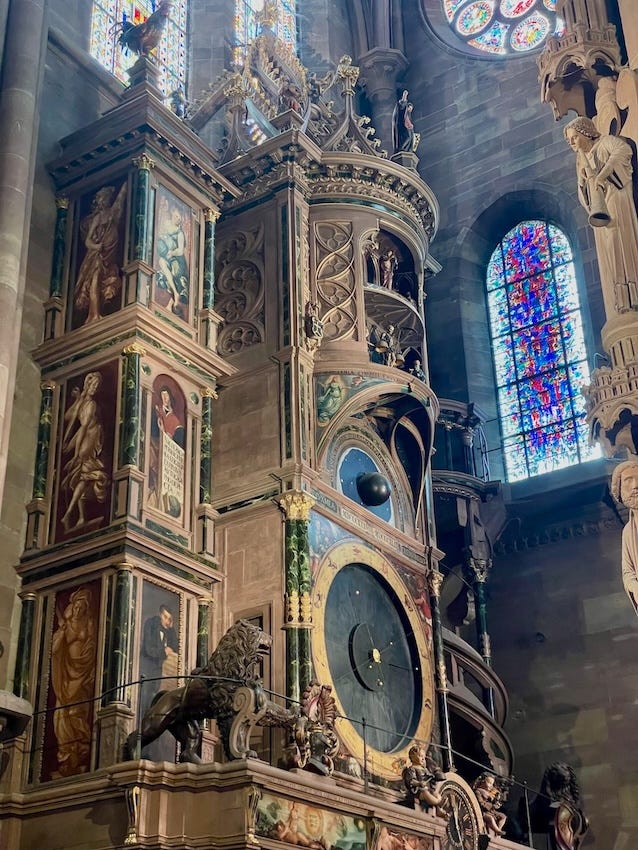
Since 2024, a college friend has come to Strasbourg each summer to dog and house sit. For three years now, we’ve visited her for a night or two, seeing a few more Strasbourg sights each time. This year, we finally made it to the astronomical clock inside Notre Dame.
At 12:30 every day, one of the cherub’s arms moves to chime a bell, and in the tower above all the aforementioned components, a rotating platform spins four figures representing the stages of life around a skeleton. The skeleton holds a bone that chimes a bell in response to the cherub. Above that circle of life and death, the twelve disciples parade around Christ. After every fourth disciple, a rooster at the top of the clock tower raises its wings and crows, corresponding to Peter’s three denials of Jesus.
You can visit the clock whenever the cathedral is open. Every quarter hour, a bell chimes and one figure takes a turn in front of the death skeleton. But the whole play – the rooster, the full disciple parade, the life cycle figures – only happens at 12:30.
This astronomical clock is Notre Dame’s third. The first, the Three Kings’ Clock, stood opposite from today’s clock. Built between 1352-1354, a wood and wrought-iron rooster automaton stood at the top of the clock. The rooster moved its wings and tail, and through a bellows and reed, it crowed. That clock stopped working around 1500, but the rooster got a second life in the second cathedral clock.
Construction on clock #2 began around 1547 by Christian Herlin. In the following years, Protestants and Catholics traded possession of the cathedral, and during the Catholics’ time, construction halted. In 1571, the Protestants regained possession, and clock construction resumed under Conrad Dasypodius, who hired multiple Swiss clock makers and artists to work on the clock. They finished in 1574, creating the sideboards and many of the decorations seen on the current clock. This clock functioned until 1788.
In a description of the clock, published in 1578, Dasypodius wrote, “To ensure that something remains as a symbol of the old clock, we have reinstalled this cockerel in the new structure.1” Considered one of the oldest automaton of this type, today that medieval cockerel lives in Strasbourg’s Museum of Decorative Arts.
A Strasbourg engineer, Jean-Baptiste Schwilgué, built the mechanism that operates the current astronomical clock. Supposedly, he visited the non-functioning clock as a nine-year-old and declared that he would make it work again one day. It took him years, but he eventually won the contract to do the work. Between 1838-1842, he made calculations and built machines to create the clockworks.
Before we visited, I knew none of these things. Friends and the internet warned us that there would be a video before the clock went off at 12:30. Knowing I had an educational video in my near future, I didn’t read up, expecting the video to tell me all.
And it did! In French and German, with English subtitles, it explained the clock’s history, and the significance of the pillar of angels across from the clock. It showed Earth’s elliptical orbit around the sun and explained how Schwilgué created a mechanism based on that orbit that would precisely move a clock hand over the course of a year.
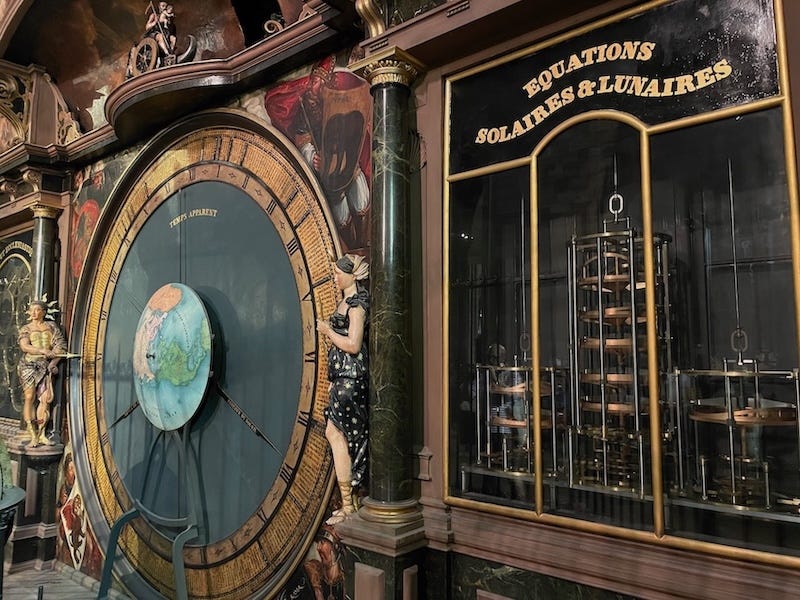
Something about the visual of the Earth’s journey moved me. I thought about how we’re constantly in motion, rotating daily, orbiting annually, and how I rarely consider this. I thought about Samantha Harvey’s Orbital and astronauts seeing Earth from space. I thought about Schwilgué undertaking the revival of the astronomical clock and his dedication to making all these calculations so this outrageous clock could track Earth’s orbit and accurately predict eclipses, and in a cathedral, next to a pillar of angels and an astronomical clock, I found myself crying at the educational video.
And then it was 12:30, an angel rang a bell, a skeleton banged another bell with a bone, and a rooster crowed so comically that all my celestial reflections flew away.
Practicalities
Visiting Strasbourg’s cathedral is free, and so is looking at the astronomical clock, unless you want to see it come alive at 12:30. For that, you pay €4. And seeing the full clock show is worth at least that much, though TripAdvisor reviewers disagree.
You can only buy same-day tickets. The side door for the clock opens at 11:30, and people line up ahead of time. If you line up earlier, you can get a good view of the clock, but you’ll also be standing for an hour inside, plus however long you waited in line outside.
We bought tickets in the shop inside the cathedral, went for coffee, and then returned around 11:45. I was stressed about being late, but we still had lots of standing time. We stood to the left of the clock, where we had a good view of the video and the English subtitles to reinforce the French and German voiceover.
Just before the clock begins moving, a member of the cathedral staff explains in French and German what will happen.
Finally, many people visit Strasbourg for its Christmas market, the largest in Europe; however, during the market, on Sundays, and on holidays with 11 a.m. masses, the clock presentation doesn’t take place.
Strasbourg recommendations
Here are a couple places we visited on this trip that I enjoyed:
Alsace à Boire - this wine bar and store had disappointing oysters but good charcuterie. We tried several wines with our snacks and left two bottles.
L’Atelier 116 - this bakery has multiple locations, and the one we went to on Sunday morning had a line out the door. Everything looks good – I had three pastries for my breakfast. The raspberry and almond croissant was worth the wait.
Sources
Musées de la ville de Strasbourg - Les collections. “Coq automate.” Accessed July 29, 2026. https://musees-strasbourg.skin-web.org/fr/document/coq-automate/6232f431cbe460020401f715?hitId=60e31d1bb4a0b5433a57d9ee&pageId=60ebf0c4f52f492b5f20a8d3&pgn=0&pos=1&v=mosaic.
Presbytère Cathédrale Notre-Dame Strasbourg. “Horloge Astronomique.” Accessed July 27, 2026. https://www.cathedrale-strasbourg.fr/horloge-astronomique.
Shubinski, Raymond. “Tour Europe’s Great Celestial Clocks.” Astronomy Magazine, February 5, 2026. https://www.astronomy.com/science/tour-europes-great-celestial-clocks/
What a spectacular clock! A self-professed Luddite, I adore analog tellers of time but this is so much more. I've never been interested in visiting Strasbourg until this very minute (12:30!).
Were we smarter back then? Or did we just use our time better? This clock seems amazing and I really hope I get to see it one day.