
Basel's Basilisks
Cave dragons and rooster executions

Early ReSwissed readers may recall that Basel is full of fountains, many of which double as small pools in the summer. There’s even a local group that occasionally heats fountains through the winter. Throughout the city, there’s a style of fountain that’s unfriendly to swimmers, but perfect for water-bottle-filling: the basilisk fountain.
I started thinking more about the basilisk after writing about the New Year’s drinking at the Trident Fountain. The wine came out of basilisks there, but the basilisk fountain is green, and features one striking monster spitting water into a shallow basin. There are 28 of these fountains around the city, and one, large, threatening, non-fountain basilisk guarding the Wettsteinbrücke, one of the five bridges across the Rhine.
I find these basilisks delightful – who wants water from a regular fountain or tap when you can get it from a monster’s mouth? If you start looking, you’ll see basilisks everywhere. There’s even a radio station called Radio Basilisk (it was playing Golden from KPop Demon Hunters when I tuned in). Explaining the basilisk as a Basel symbol because the names are similar felt facile. So… let’s find out what the deal is with these.
What is a basilisk?
The basilisk is a mythical creature that, at various times, was described as having a rooster’s head and a snake’s body; a combination rooster-bat-snake; or, if you’re the author of a boy-wizard series, just a huge snake. In all cases, meeting the basilisk’s gaze was deadly.
Roman naturalist Pliny the Elder included the basilisk in his 79 CE Natural History. Before that, it appeared in Greek mythology. Per Pliny, the basilisk looked like it wore a white crown. He may have been describing a cobra, but he also wrote that its breath could kill plants and break stones, and that the only way to exterminate the basilisk was to drop a weasel in its cave. Later, the tales about the monster only grew more extreme: it could kill birds flying above it, it could kill by its hiss. Isidore of Seville, a 7th century bishop, borrowed from Pliny, among others, when writing his Etymologiae, book 12 of which was about animals. His basilisk retained all the poison and deadliness ascribed by his sources, and it was only “half a foot in length.”
Here is the basilisk entry from the Aberdeen Bestiary, an illuminated manuscript written in England around 1200:
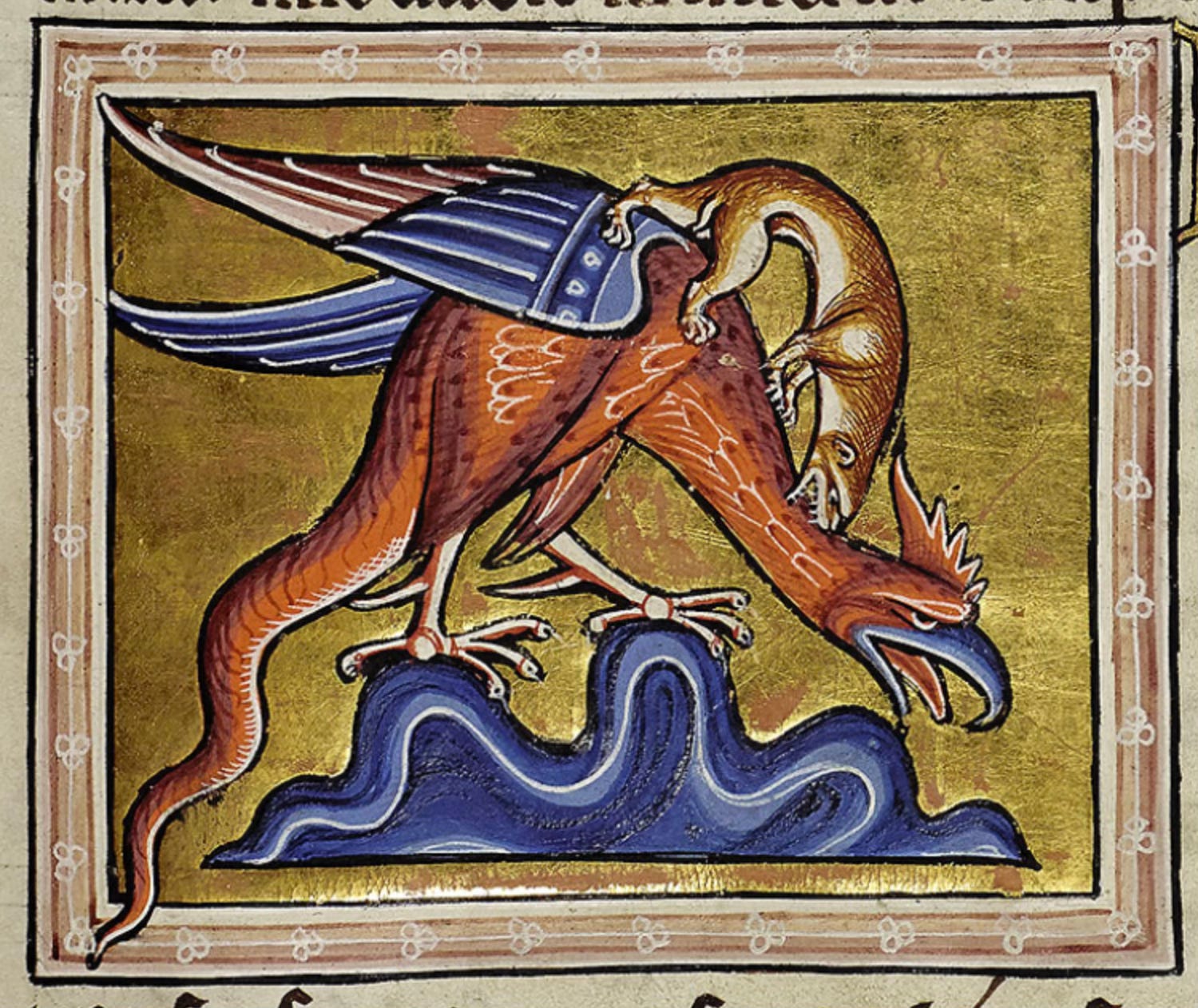
“Of the basilisk.
The basilisk’s name in Greek, translated into Latin, regulus, means ‘little king’. It is so called because it is the king of crawling things, who flee when they see it, because it kills them with its scent. It will even kill a man just by looking at him. Indeed, no bird can fly past unharmed by its gaze but, however far away, will be burnt up and devoured in its mouth. The basilisk can be conquered by weasels. Men put them into the caves where the basilisks lie hidden. The basilisk, seeing the weasel, flees; the weasel pursues and kills it. For the Creator has made nothing without a remedy. The basilisk is half-a-foot in length, with white stripes. Of the basilisk, or regulus [continued] Basilisks, like scorpions, seek out dry places; after they have come to water and bite anyone there, they make that person hydrophobic and send them mad. The creature called sibilus is the same as the regulus, or basilisk; for it kills with its hiss before it bites or burns.”
Pierre de Beauvais’s thirteenth century Medieval Bestiary detailed the necessary conditions for a basilisk’s creation: a rooster had to lay an egg in animal feces, and then a toad had to incubate it. This egg would hatch a creature with a rooster’s head, a snake’s tail, and bat wings. Then it would retreat to a dry, sheltered spot like a cave, well, or cellar, and wait for a chance to stare someone to death.
Legendary Basel Basilisks
Supposedly, a basilisk once lived in a cave in the Gerberberglein (little Gerber mountain), a hill in central Basel. There’s an easily-missed fountain built into the hill with an inscription commemorating that basilisk and its cave. I’ve walked by this spot countless times and only saw the fountain when I went looking for it.
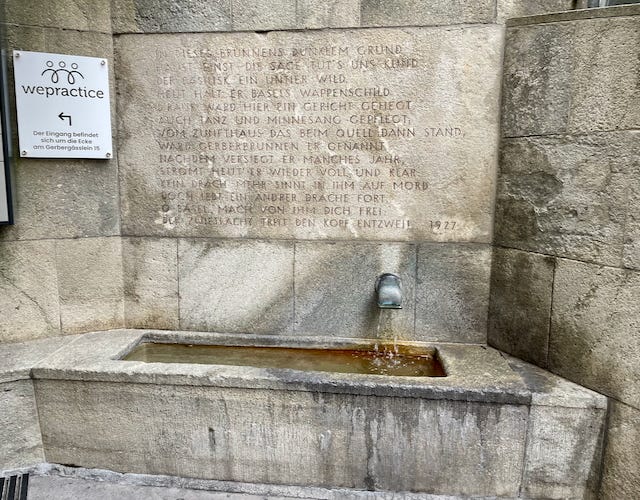
The inscription reads:
“In the dark depths of this well,
once lived—as legend tells—
the basilisk, a wild beast.
Today it adorns Basel’s coat of arms.
Here, justice was administered,
and dancing and minstrelsy cultivated;
from the guild house that stood by the spring,
it was called Gerberbrunnen.
After drying up for many years,
today it flows again, full and clear.
No dragon plots murder in it anymore,
but another dragon lives on,
O Basel, free yourself from it:
discord splits the head in two!”
It’s unclear how far back this story of the basilisk goes; it first appeared in writing in 1476. It was said – even written in the 1547/48 Chronicle of the Swiss Confederation – that the city’s name came from this basilisk.
Meanwhile, in 1474, Basel residents beheaded and burned a rooster for laying an egg in the middle of the street. Before the burning, the executioner cut open the rooster and found three more eggs. Per the Swiss National Museum’s post about the 1356 Basel earthquake (in German), this unnatural egg hatched after a plague in 1349, followed by the earthquake, and then a city fire in 1417, so it’s understandable that citizens wouldn’t want to risk a basilisk emerging from that egg.
More on basilisks next week – including the stories behind the most prominent basilisks around the city today (in other words, more fountain content).
Sources
Krzyszczuk, Łukasz, and Krzysztof Morta. 2023. “Basilisk - the History of the Legend.” Alea: Estudos Neolatinos 25 (1): 277–306.
Badke, David. n.d. “Medieval Bestiary : Introduction.” Medieval Bestiary. Accessed January 18, 2026. https://bestiary.ca/intro.htm.
Meyer, Benedikt. 2019. “Das grosse Beben von Basel.” Blog zur Schweizer Geschichte - Schweizerisches Nationalmuseum, February 11. https://blog.nationalmuseum.ch/2019/02/das-grosse-erdbeben-von-basel/.
Rebman, Roger Jean. 2009. “Gerberbrunnen Am Gerberberglein.” Altbasel.Ch, June 15. https://altbasel.ch/fussnoten/brunnen_gerberbrunnen.html.
Ungvarsky, Janine. 2024. “Basilisk.” EBSCO. https://www.ebsco.com/research-starters/zoology/basilisk.
Who knew fountains could be so scary?