
Postcard from a German lake
And ranting against the German train system

We traveled to Berlin and Halberstadt, Germany last week and at the time of writing (Thursday), are on the Deutsche Bahn (DB) home. Will we arrive at 7:48 pm, already 30 minutes later than the originally scheduled arrival time, a change DB made me aware of two weeks before the trip. Will the final leg of the trip from Hildesheim to Basel actually happen, or will it stop in Frankfurt and force all continuing passengers to find an alternate train home? Who can say!
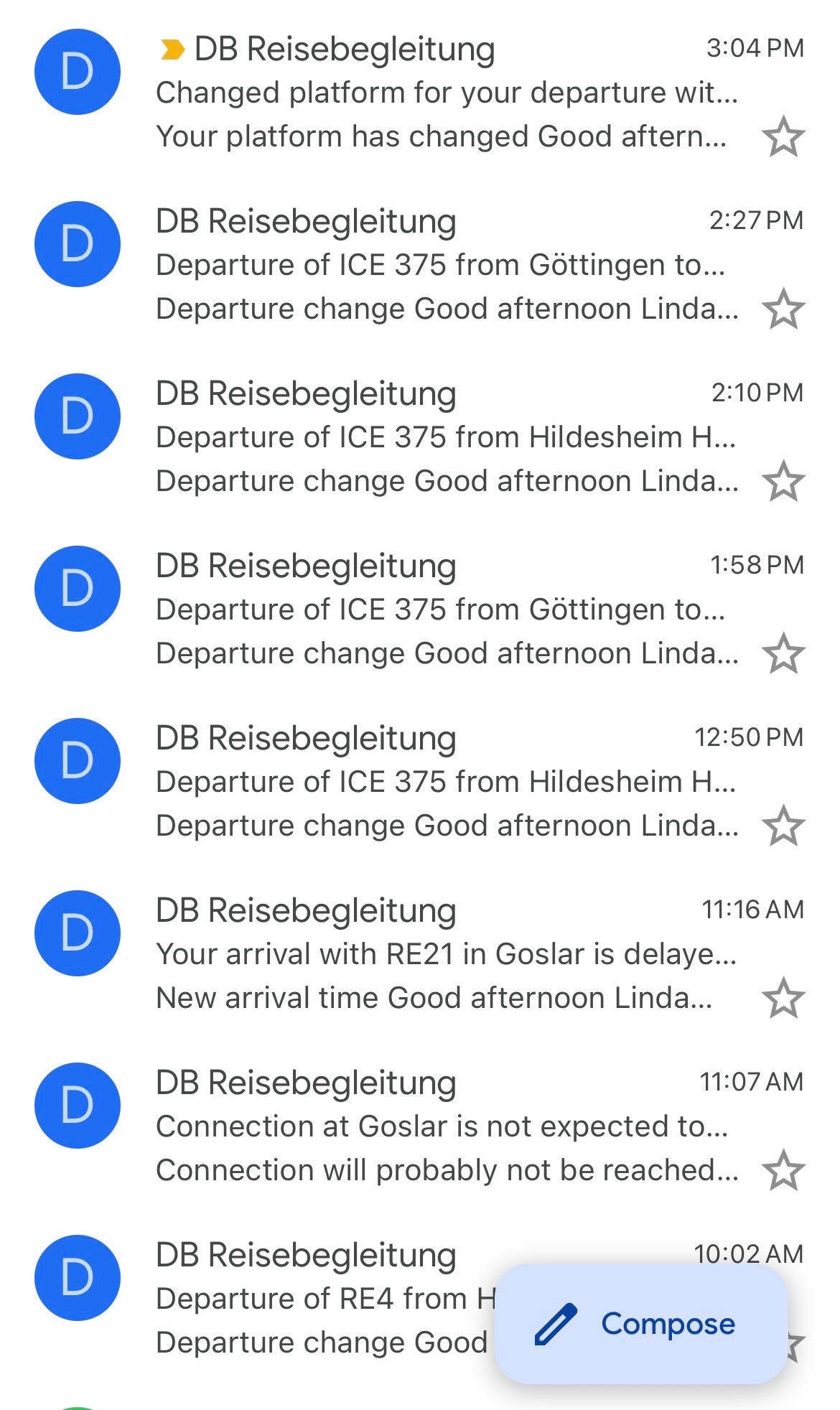
For the uninitiated, DB is laughably dysfunctional. When I mentioned this to a visiting American friend, he said, “Oh, I thought they were very punctual.” Well, not anymore. The day before we left Berlin, our friend gamed out several alternate routes to get us home, should we miss our four-minute connection in Goslar. And miss it we did, as our first train arrived at 11:58 and our scheduled connection left at 11:56.
Enough about our transit drama. We spent four days in Berlin with friends, ending with a visit to a four-story bookstore called Dussmann, where I could easily have spent a half day browsing their English section. After books and lunch, we took two local trains and a bus to Strandbad Wannsee, an open-air lido (public pool) on a lake with a 1.2 kilometer beach.
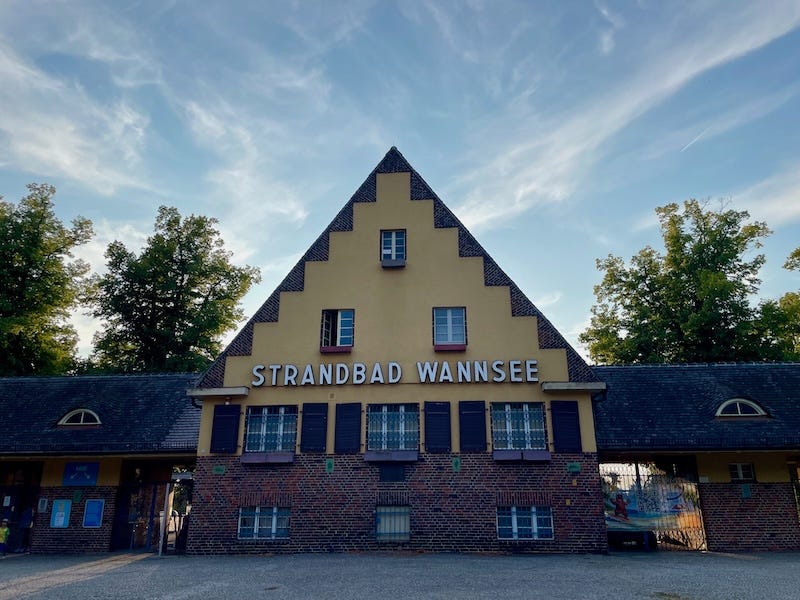
Wannsee had a swimming area as early as 1907, and an official beach since 1909, when it was divided into a men’s and women’s section, with a family section in between. The buildings along the lake that house the snack bars, first-aid station, toilets, and changing rooms were built in 1929-1930 and are under historic preservation today.
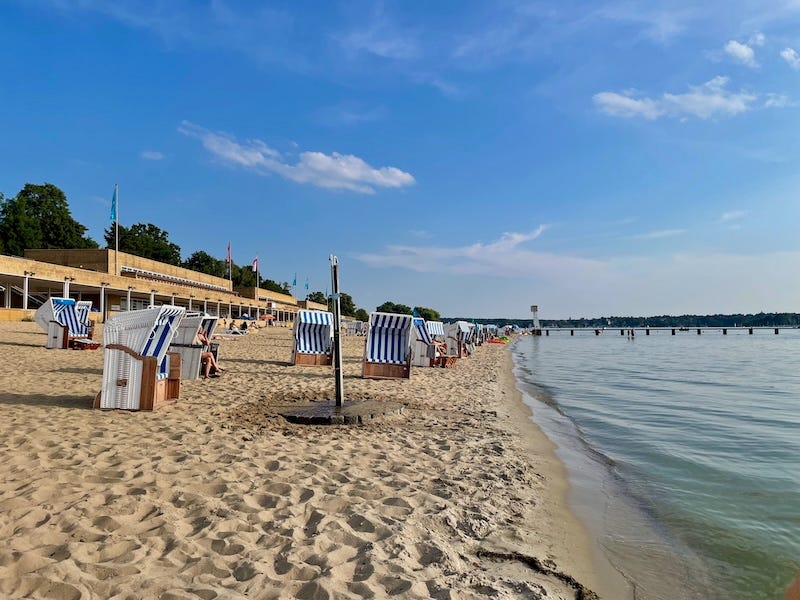
This was my first German lake-swimming experience, and the sand offered a change to the concrete steps and rocky beaches along the Rhine. Rhine swimming is free, and entry to the Strandbad is €6.50, but that is a reasonable price to pay to cool off and escape the city (it’s €3.80 for kids, students, and welfare recipients).
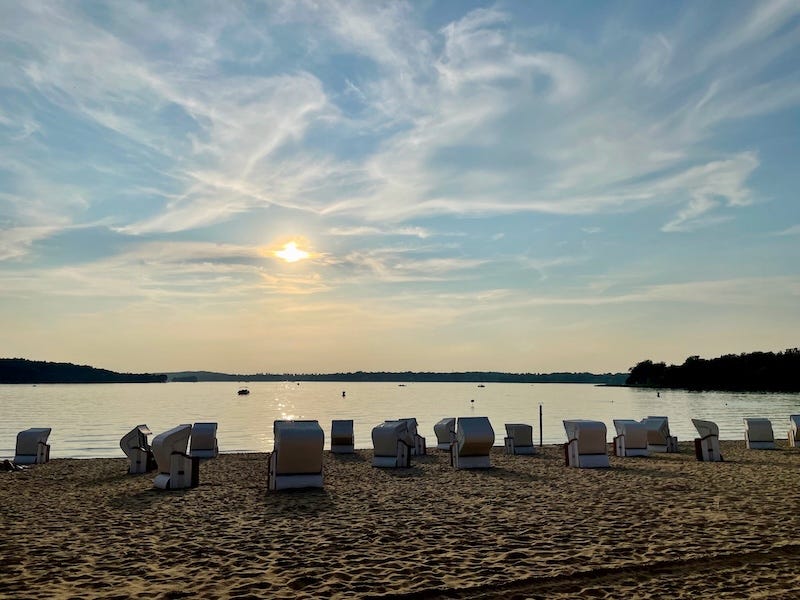
A small section of the beach is reserved for nude bathers. We set up near the border, and along with our friends, I popped over for my first Freikörperkultur (literally, free body culture) swim. I would do it again, but it was a bit strange for someone used to bathing suits. And I wouldn’t do it along the Rhine, even though there is a small nude beach.
While nakedly swimming out toward a buoy, I spotted a cormorant with an eel in its beak. We watched the two struggle, but in the end, the cormorant won by swallowing the eel whole.
More on our German travels and what took us to Halberstadt next week. Thank you, as always, for subscribing to ReSwissed, and should you plan a train trip through Germany, you’ve been warned. Plan alternate routes ahead of time.
Sources
“Strandbad Wannsee | Berliner Bäder-Betriebe.” Accessed August 6, 2026. https://www.berlinerbaeder.de/baeder/detail/strandbad-wannsee/.
“Strandbad Wannsee.” Wikipedia. Accessed August 6, 2026. https://en.wikipedia.org/wiki/Strandbad_Wannsee
We paid 5,20€ for Wannsee because we bought the tickets online!
I want someone to do the actual reporting of how famed German train system known for being on time degraded to this extent! I don’t mean you unless you want an unpaid assignment but I really wonder. Oddly in DC the Metro has done a 180 and improved so much they opened a pop-up shop of Metro merch this summer and there were LINES to get in and they sold out w/in days and had to restock. The one happy thing for a city under occupation!